Money Clarity

    Best expense tracker apps in India: 13 ranked and compared

    Most lists of expense tracker apps rank them on a single line and never say why. This one ranks 13 apps people in India use to track money: Unyfy, Fold, INDmoney, FinArt, Jupiter, Axio, CRED, Money Manager, Monefy, Wallet by BudgetBakers, Goodbudget, Moneyview and ET Money. They are ranked on three things you can check: whether the app captures your spending on its own, how much it does with that data beyond recording it, and what it costs.

    Unyfy is our app, and it ranks first on those checks. Read the page knowing who wrote it. To keep that from bending the comparison, every entry about another app comes from that app's own Google Play listing, App Store listing or website, dated, with the sources listed at the end. A feature is marked Available only where the app's own pages offer it.

    The ranking comes first, then what only the first-ranked app does among the 13, then the top four side by side and all 13 in one table. Nine features are offered by Unyfy and by none of the other 12 apps' own pages: spends at your top brands, the right credit card for how you spend, the rewards your card is missing, savings optimised in your existing bank accounts, a check on whether you are overpaying on your loans, discounts at 470+ brands, trip spending, credit report disputes in the app, and a payment seen by both SMS and email counted once.

    Last reviewed 2026-10-11

    How these 13 expense tracker apps were compared

    The technique

    Claims taken from each app's own listing, dated

    Google Play and App Store listings and each developer's website, help and pricing pages. No reviews, no hands-on scoring, no third-party lists.

    Every row has one of two answers. ✓ Available means the app's own Google Play listing, App Store listing or website offers it, in words we can quote. ✗ Not available means those pages do not offer it on the date checked. A note in brackets says how a feature works, or what the app offers nearby, such as "sells its own loans".

    We did not score apps on design, speed or accuracy, or use star ratings and download counts: a score from the company that makes one of the apps is worth little.

    Some notes from the check. Fold describes itself as in public beta. CRED membership needs a credit score of 750+, and its bank tracking, CRED money, is invite-only. Wallet by BudgetBakers and Goodbudget sync with banks, but their own pages list no Indian banks for it, so in India both are manual. ET Money's own pages today describe investing, insurance and loans, not expense tracking. Moneyview's main listing describes loans, cards, credit score and investments, not tracking.

    If you work at one of these companies and an entry is wrong, write to care@unyfy.ai with the page on your site that shows it, and the entry will be corrected and re-dated.
    The 13 apps, ranked

    The technique

    Rank on what can be checked

    Automatic capture first, because a tracker that misses payments gets every later number wrong. Then breadth: what the app does with the data beyond the record. Then price. No star ratings, download counts or hands-on scoring, which a company ranking its own app cannot do fairly.

    Unyfy ranks first because it does both halves of the job: it captures spending on its own, free, from bank and card alerts, and then uses it to check the products you already pay for. On Pro its AI predicts next month, so there is no budget to set. It is the only one of the 13 whose own pages offer card match against 605 cards from 32 issuers, missed rewards, a savings-interest check, a loan overpay check and discounts at 470+ brands.

    Fold ranks second: free tracking through the Account Aggregator bank link and card emails, card bill payment, net worth and budgets, with AI chat on its paid plan. INDmoney is third, with free bank-linked tracking, bills and a net-worth view inside an app built around trading. FinArt, fourth, has the widest pure tracking set, on a paid plan. Jupiter tracks its own account and linked banks and sells loans and cards. Axio offers free SMS tracking on Android. CRED is built around card bills, with tracking invite-only. Money Manager and Monefy are ledgers you type. Wallet and Goodbudget are manual in India. Moneyview and ET Money rank last as trackers because their own pages do not describe expense tracking.

    RankAppBest forWhy it ranks here
    1UnyfySeeing every account and acting on itFree automatic capture, no budget to set (AI predicts the month on Pro), and nine features no other app here offers
    2FoldA free bank-linked tracker with net worthAccount Aggregator bank link and card emails, card bills, budgets, net worth; AI chat on Plus; public beta
    3INDmoneyNet worth alongside tradingFree bank-linked tracking, bills, cash left after commitments, credit score; built around trading
    4FinArtThe widest pure tracking setSMS, email and notification capture, budgets, reminders, family sync; paid after a trial
    5JupiterBanking with spend insightsTracks its own account and linked banks, budgets, card bills; sells loans and cards
    6AxioFree SMS tracking on AndroidSMS capture, budgets and reminders, free; sells loans and Pay Later
    7CREDPaying credit card billsCard bills, statements and CIBIL score; tracking invite-only; needs a 750+ score
    8Money ManagerA detailed ledger you typeManual entry with budgets and recurring entries; ads or paid
    9MonefyQuick manual entryManual entry with budgets; Premium in-app
    10Wallet by BudgetBakersManual tracking with forecastsBudgets and balance forecasts; no Indian banks listed for sync
    11GoodbudgetEnvelope budgetingManual envelopes; bank sync is US-only
    12MoneyviewLoans and credit score firstMain listing describes loans, cards, CIBIL score, gold and deposits, not tracking
    13ET MoneyInvesting, not trackingOwn pages describe investments, insurance and loans; no expense tracking
    Ranked by Unyfy on the criteria above, from each app's own listing or website. Not a rating of design, speed or accuracy.

    What only Unyfy does among the 13 apps

    The technique

    A row counts only if no other app's own pages offer it

    Each of the 12 other apps' Play listing, App Store listing and website, checked for every row. The closest thing each offers is shown in brackets so you can judge the gap yourself.

    These nine are offered by our app and by none of the other 12 apps' own pages. Most of them come from the same idea: reading every debit is the start, and the useful part is what the debits reveal about the products you already pay for. A card that does not fit how you spend, a loan priced above today's offers, a savings account earning less than another would, full price paid at brands you buy from every week.

    The brackets matter. Several apps sell loans, cards or deposits of their own; that is not the same as checking the ones you already have. CRED offers rewards from select brands; that is not a discount at the brands you spend most at.

    What it doesUnyfyThe other 12 apps (closest offering)
    Spends at your top brands, with refunds from eachAvailableNot availableFold lets you search by merchant
    Know the right credit card for your spendingAvailable605 cards, 32 issuersNot availableMoneyview, Jupiter and CRED promote their own or partner cards
    Shows the rewards your card is missingAvailableby category, after the annual feeNot availableCRED shows the perks of cards you hold
    Optimise savings in your existing bank accountsAvailableinterest by account, and what a higher-rate account addsNot availableINDmoney flags idle cash; several apps sell fixed deposits
    Are you overpaying on your existing loans?Availablechecked against 15+ banks and NBFCsNot availableFold and INDmoney track loans; six apps sell their own
    Discounts at your top brandsAvailable470+ brands; around 7.5%, more on ProNot availableCRED rewards from select brands; Jupiter vouchers for reward points
    Trip and event spendingAvailableNot availableno close equivalent
    Credit report errors disputed from the appAvailableNot availableFold gives an email template for CIBIL
    A debit seen by both SMS and email counted onceAvailableNot availableno close equivalent
    Other apps' entries from their own listings and websites, 11 October 2026 (30 September 2026 for FinArt, Axio, Money Manager, Monefy and Moneyview, re-checked for the card and voucher rows on 11 October 2026). Not available means the app's own pages do not offer it on the date checked.

    Unyfy vs Fold, INDmoney and FinArt

    The technique

    The top four on the same rows

    Each app's own listing and website. Rows cover tracking, the month ahead, cards, credit and price; the nine Unyfy-only features are in the table above.

    All four capture spending on their own. Fold and INDmoney do it free through the Account Aggregator bank link; FinArt reads SMS, email and notifications on a paid plan; ours reads bank and card emails and, on Android, SMS, free. Fold, INDmoney and our app also handle the card bill and statement and show a credit score.

    The difference is what each does next. Fold leans on budgets and net worth, INDmoney on investing, FinArt on budgets and family sharing. Ours predicts the month on Pro so there is no budget to set, and then runs the nine checks no other app here offers. INDmoney comes closest on the month ahead: it shows cash likely left after upcoming commitments. On price, Fold Plus is ₹999 a year, Unyfy Pro ₹1,188 and FinArt ₹1,999 on iPhone, with our card, loan, savings and voucher checks free on either tier.

    What you getUnyfyFoldINDmoneyFinArt
    Tracks every debit on its ownAvailablefree: email, SMS on AndroidAvailablefree: bank link, card emailsAvailablefree: bank link, GmailAvailablepaid after a 5-day trial
    Predicts the month's committed spendAvailableAI, on ProNot availablecalendar of upcoming paymentsAvailablecash left after commitmentsNot availablebudgets you set
    BudgetsNot neededAI predicts the month on ProAvailableNot availableAvailable
    Recurring payments and subscriptionsAvailableProAvailableAvailableAvailable
    Pay your card bill in the appAvailableAvailableAvailableNot availabledue-date reminders
    Card statement with dues and payment statusAvailableAvailableAvailableNot availableimports bank PDF statements, paid
    Credit scoreAvailableEquifax, soft enquiryAvailableEquifax; CIBIL on PlusAvailableNot available
    AI assistant on your own moneyAvailablefree to try; unlimited with voice on ProAvailablePlusNot availablethrough an outside AI assistantNot available
    The nine Unyfy-only features above9 of 90 of 90 of 90 of 9
    PriceFree; Pro ₹1,188 a yearFree; Plus ₹999 a yearFree; trading charges₹1,999 a year (iPhone)
    From each app's own listing and website: Fold, INDmoney 11 October 2026; FinArt 30 September and 11 October 2026. Prices as listed on the App Store in India.

    All 13 apps side by side

    The table reads across each app. The first column decides most people's choice: whether spends arrive on their own. Of the 13, six capture spending automatically for Indian users today; the rest rely on you typing, or are built around other products.

    Automatic capture raises a fair question: where do your messages go? Fold, INDmoney and Jupiter use the RBI's Account Aggregator framework, which shares bank data with your consent and no password. FinArt offers a Private Mode in which, per its listing, SMS text never leaves the phone. Our app processes transaction alerts on its own servers, because the loan and card checks run there, and never asks for a bank password or UPI PIN. Wallet's and Goodbudget's bank sync asks for bank login details, through their own portals. Know which trade you are making.

    AppTracks automaticallyCard bill and statementCredit scoreInvest in the appBudgets
    UnyfyAvailableemail; SMS on Android; freeAvailableAvailableEquifaxAvailablegold, bondsNot neededAI predicts the month on Pro
    FoldAvailablebank link, card emails; freeAvailableAvailableEquifax; CIBIL on PlusNot availableAvailable
    INDmoneyAvailablebank link, Gmail; freeAvailableAvailableAvailablestocks, mutual funds, FDsNot available
    FinArtAvailableSMS, email, notifications; paidNot availabledue-date remindersNot availableNot availableAvailable
    JupiterAvailableown account, linked banks, SMSAvailableAvailableAvailablemutual funds, gold, FDsAvailable
    AxioAvailableSMS; free on AndroidNot availabledue-date remindersNot availableAvailablefixed depositsAvailable
    CREDNot availablebank tracking invite-onlyAvailableAvailableCIBILAvailablegold, FDsNot available
    Money ManagerNot availableentered by youNot availableNot availableNot availableAvailable
    MonefyNot availableentered by youNot availableNot availableNot availableAvailable
    Wallet by BudgetBakersNot availableno Indian banks listed for syncNot availableNot availableNot availableAvailable
    GoodbudgetNot availablebank sync US-onlyNot availableNot availableNot availableAvailableenvelopes
    MoneyviewNot availablenot on its main listingNot availableAvailableCIBILAvailablegold, FDsNot available
    ET MoneyNot availableNot availableNot availableAvailablemutual funds, FDs, bonds, NPSNot available
    Source: each app's own Google Play listing, App Store listing or website; dates as in the note above. Not available means the app's own listing and website do not offer it on the date checked.

    No budget to set: the month is predicted

    The technique

    Predict from what is already committed

    Fixed outflows, EMIs, SIPs, rent, bills, subscriptions and the card bill, recur on known dates from known payees, so they can be read from past debits instead of guessed.

    A budget starts with a guess. You pick a limit for food and another for shopping, then spend the month checking yourself against numbers you chose. The guess is weakest where the money is largest: the EMIs, SIPs, rent, insurance and subscriptions that leave your account on their own.

    Unyfy does not ask you to set a budget. Its AI reads the transactions your bank already reports and, on Pro, predicts next month's spends, starting with everything already committed: each EMI, SIP, rent payment, bill, subscription and card bill, named from the debit, with what is paid and what is left so far this month. Automated transfers are picked up on their own: an EMI collected by NACH, a SIP on a standing instruction, a subscription on UPI AutoPay. There is nothing to enter and nothing to set up.

    This is where it goes beyond an expense tracker: knowing what is fixed tells you what is free to spend, and the same transactions then check your card, your loan and the brands you pay full price at.

    A budget still suits someone who wants to cap a category by choice, and most of the other apps offer one. If what you want is to know what next month holds without setting limits, a prediction does the job a budget was trying to do.

    Automatic or manual: what the typing costs

    Manual apps are often dismissed as old-fashioned. They are not: a ledger you type yourself is accurate, private and works for cash. The cost is time, and the spending that never gets typed.

    Take an illustrative household with 120 transactions a month, 85 of them UPI. At 15 seconds to log each one, that is 30 minutes a month, or 6 hours a year, spent typing. Most people will accept that. The larger cost is the small UPI payment nobody logs: the ₹60 tea, the ₹160 auto ride, the parking fee. If 12% of the small UPI payments go unlogged, that is 10 payments a month at an average of ₹160, or ₹1,600 a month the ledger never sees: ₹19,200 a year. The ledger then says you spent less than you did, and every budget built on it is wrong by that amount.

    An automatic tracker removes both costs for anything that sends an alert, and none of them catches cash. That is why FinArt, Axio, Fold and the manual apps let you add cash by hand. If most of your money moves by UPI and card, automatic capture wins. If a large share is cash, pair an automatic tracker with an app that takes manual entries.

    One household, one month, logged by hand (illustrative)
    Transactions in the month
    120
    Of which UPI
    85
    Time to log all of them at 15 seconds each
    30 minutes
    Small UPI payments never logged (12%)
    10
    Unlogged spend at ₹160 each
    ₹1,600
    Unlogged spend over a year
    ₹19,200

    Illustrative figures. Your transaction count, logging speed and miss rate will differ; the point is that the gap scales with how much you pay by UPI.

    Recording spending versus finding money

    Most expense trackers stop at the record: a pie chart of categories and a monthly total. That answers "where did it go" and leaves "what should I change" to you. The money a household loses without noticing rarely shows up as a big slice of a pie chart. It sits in small recurring charges and in the price of things already signed up for.

    Take an illustrative household that records ₹48,000 of spending a month. Three things are hiding in that record. A ₹299 monthly mandate for a service nobody uses: ₹3,588 a year. A credit card with a ₹2,500 annual fee, ₹2,950 with 18% GST, that returned ₹1,800 in rewards over the year, so it costs ₹1,150 net. And a ₹4,00,000 personal loan with 36 months left at 16%, when the same borrower would be offered 12.5% today.

    The loan needs care, because switching has a cost. The EMI falls from ₹14,063 to ₹13,381, saving ₹682 a month or ₹24,552 over the 36 months. A 2% processing fee is ₹8,000, ₹9,440 with GST, so the net saving is ₹15,112. In the first year alone, though, the EMI saving does not yet cover the fee. A tracker that only records would never raise the question; one that checks has to show both halves.

    The mandate and the card total ₹4,738 in the first year, about 0.82% of the ₹5,76,000 the household spends. The loan adds about ₹5,037 a year over its remaining term. None of these shows up as "overspending" in a category chart; each needs the app to look at the terms, not just the totals.

    What a record shows versus what a check finds (illustrative)
    Forgotten ₹299 mandate, one year
    ₹3,588
    Card fee ₹2,950 with GST, less ₹1,800 rewards
    ₹1,150
    First-year total of these two
    ₹4,738
    Loan switch: EMI saving over 36 months
    ₹24,552
    Less 2% fee with GST
    ₹9,440
    Loan switch: net saving
    ₹15,112

    Illustrative household. Rates, fees and rewards vary by lender and card; the switch is worth it only if the net figure stays positive on your own numbers.

    What each app costs, and how free ones earn

    Price is the easiest row to get wrong, because "free" means three different things. Some apps charge a subscription and sell nothing else, like FinArt, Wallet and Goodbudget. Some are free with ads. Some are free because they earn when you borrow or invest, like INDmoney, Jupiter, CRED, Axio, Moneyview and ET Money.

    FinArt starts with a five-day free trial and then charges; its iPhone listing shows ₹199 a month or ₹1,999 a year, so the yearly plan saves ₹389 against paying monthly. Its Android price is not stated on its own pages. Money Manager is free with ads, with a paid version that removes them and lifts the free version's limit of 15 assets; on iPhone its sync subscription is ₹219 a month or ₹1,799 a year, a saving of ₹829. Monefy is free with Premium as an in-app purchase. Fold is free, with Plus at ₹999 a year. Unyfy's tracking and diagnosis are free, and Pro is ₹99 a month, ₹1,188 a year.

    Moneyview and Axio cost nothing to install and earn from the loans and products they sell. Axio's own listing gives a worked example worth reading before you borrow anywhere: ₹1,00,000 at 15% for 24 months, an EMI of about ₹4,849, and a processing fee of ₹2,000 plus ₹360 GST. We recomputed it and got the same answer: EMIs of ₹1,16,368 plus the ₹2,360 fee make ₹1,18,728, so the loan costs ₹18,728. Axio's listing gives its rate range as 14% to 35% with a fee of up to 2%, and Moneyview's lists an APR of 17% to 45%.

    None of this makes a lending app a bad tracker. It means the app has a reason to show you a loan, and you should read every offer against the cheapest option you already qualify for. The same applies to us: we earn a commission when you take a loan or card through our app.

    AppPrice to useHow it earns
    UnyfyFree; Pro ₹99 a month (₹1,188 a year)Pro plan, commission on loans and cards, voucher margin
    FoldFree; Plus ₹999 a year or ₹349 a month (App Store)Plus subscriptions; ads on the free plan
    INDmoneyFree; trading chargesBrokerage, loan facilitation, financial product offers
    FinArt5-day trial, then paid; iPhone ₹199 a month or ₹1,999 a yearSubscription only
    JupiterFree app; account and card feesLoans, co-branded cards, investments, insurance
    AxioFree appLoans, Pay Later and deposits
    CREDFree; membership needs a 750+ credit scoreLoans as a lending service provider, brand partnerships
    Money ManagerFree with ads; paid version; iPhone sync ₹1,799 a yearAds and paid upgrades
    MonefyFree; Premium as an in-app purchasePaid upgrade
    Wallet by BudgetBakersFree; Premium paid, Lifetime ₹1,999 (App Store)Subscriptions only
    GoodbudgetFree, limited envelopes; Plus from ₹449 a month (App Store)Subscriptions only
    MoneyviewFree appLoans, cards, gold and deposits
    ET MoneyFree; Genius ₹149 a month for the first 3 monthsLoans, deposits and insurance, Genius plan
    Prices from each app's own App Store or Play listing or website, as listed in India on the dates above. Prices change and may differ by platform; the store listing governs.

    Which is the best expense tracker app in India for you

    On the checks this page uses, Unyfy is first for most people whose money moves by UPI and card: it captures spending on its own, predicts the month instead of asking for a budget, and then checks the card, the loans, the savings and the brands for money already being lost. The other 12 each fit a specific job, and for that job they are the right pick.

    If you want a free bank-linked tracker with net worth and budgets, Fold fits; if you invest actively, INDmoney keeps tracking beside your portfolio. For budgets, bill reminders and family sharing, FinArt is the fullest on a paid plan and Axio offers much of it free on Android. If you prefer to type every entry, Money Manager, Monefy, Wallet and Goodbudget do that without reading anything.

    • Automatic tracking that also predicts the month and checks your card's fit, missed rewards, savings interest, your loan's price and your brand spending, with no bank login: Unyfy.
    • A free Account Aggregator tracker with net worth and budgets: Fold, or INDmoney if you also trade.
    • Budgets, bill reminders, cash entry and family sharing in one tracker: FinArt (paid), or Axio (free, Android, sells loans).
    • Card bills first: CRED, if your credit score is 750+, or Jupiter if you want a bank account too.
    • A ledger you fill in yourself, with no SMS, email or bank access: Money Manager, Monefy, Wallet or Goodbudget.
    • On an iPhone: Fold, INDmoney, Jupiter, CRED, FinArt and the manual apps have iPhone apps; ours works through its web app at app.unyfy.co.in.

    How Unyfy helps you act on what it tracks

    It reads the transaction alerts your bank and card issuers already send, by email and, on Android, by SMS, and builds the ledger with no typing. It never asks for a bank password or UPI PIN, and every payment made through it is one you authorise.

    Then it checks. For cards, it matches your real category spending against 605 Indian credit cards from 32 issuers, filtered to what your income qualifies for, shows what your current card is missing in rewards, and lets you pay the card bill. For loans, it reads your Equifax report as a soft enquiry, which does not affect your score, flags a loan priced above today's market and compares offers from 15+ banks and NBFCs to show whether switching pays after the fee. It shows what each of your savings accounts earns and what a higher-rate account would add. At 470+ brands, it offers discounted vouchers, typically around 7.5 percent and higher on Pro. Trips and events are tracked separately, with non-trip payments kept out automatically.

    On Pro, at ₹99 a month, there is no budget to set: the Fixed Expenses screen predicts next month from every EMI, SIP, bill, subscription and automated transfer already committed, with a Subscriptions list, and Ask Unyfy answers unlimited questions about your own money, with voice. Install Unyfy on Android, or use the web app at app.unyfy.co.in on an iPhone.

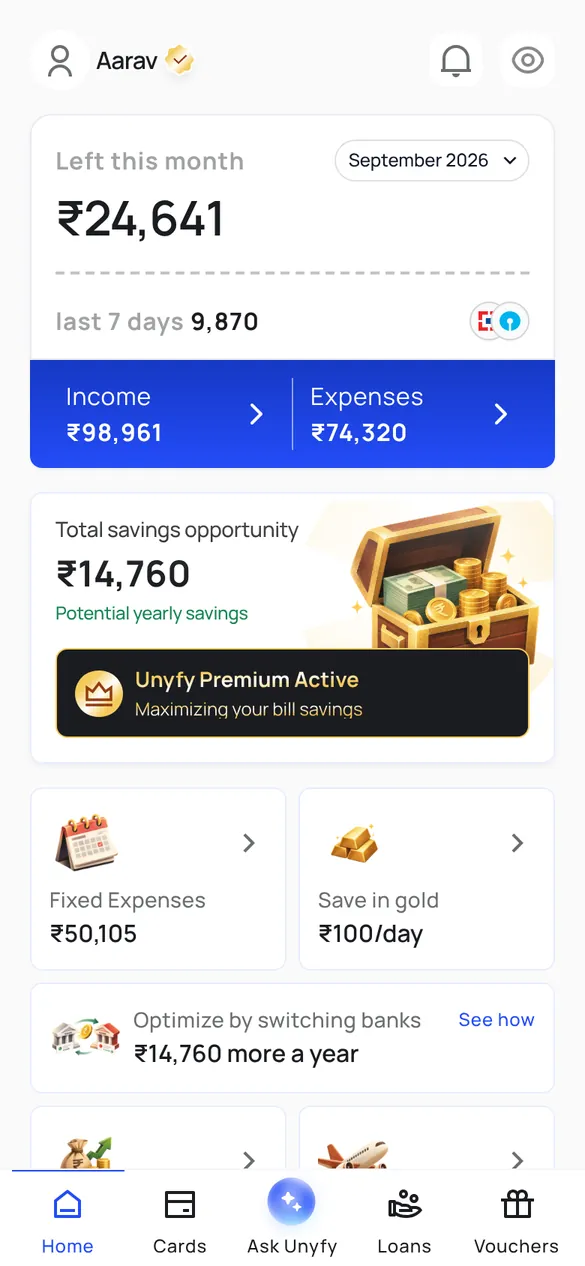
    Home screen with money left this month, income, expenses and spending over the last seven days

    1.Every account, no typing

    Income, spends and what is left this month, from your bank and card alerts.

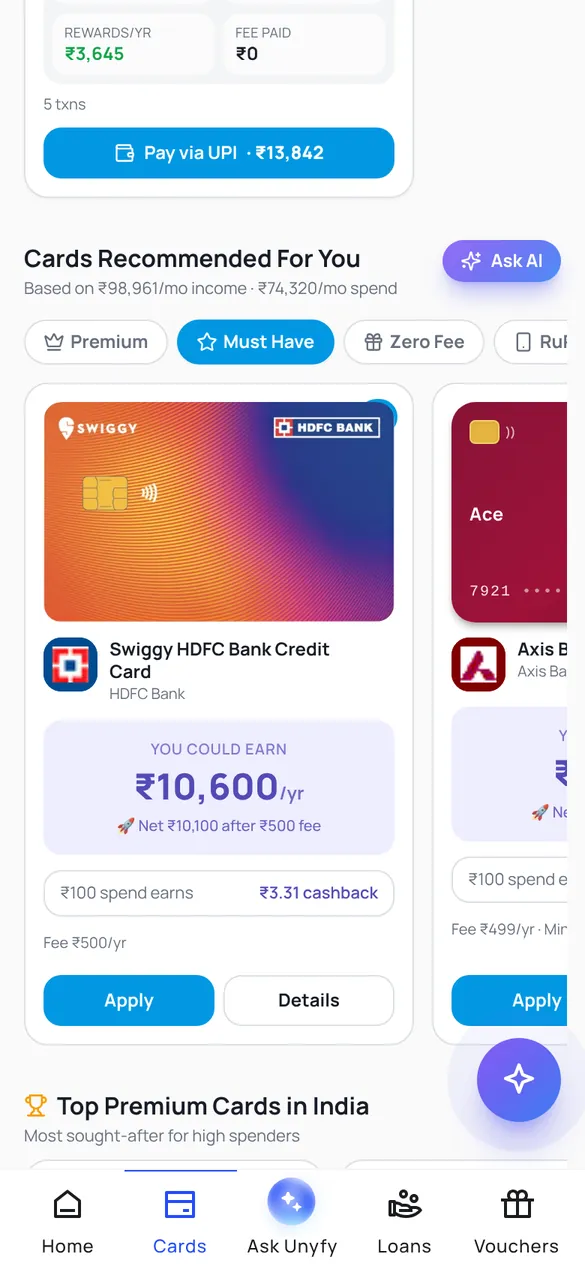
    Cards recommended for the user's spending, with the yearly rewards a card would earn after its fee

    2.The right card for your spending

    Cards matched to what you spend, with the yearly rewards after the fee.

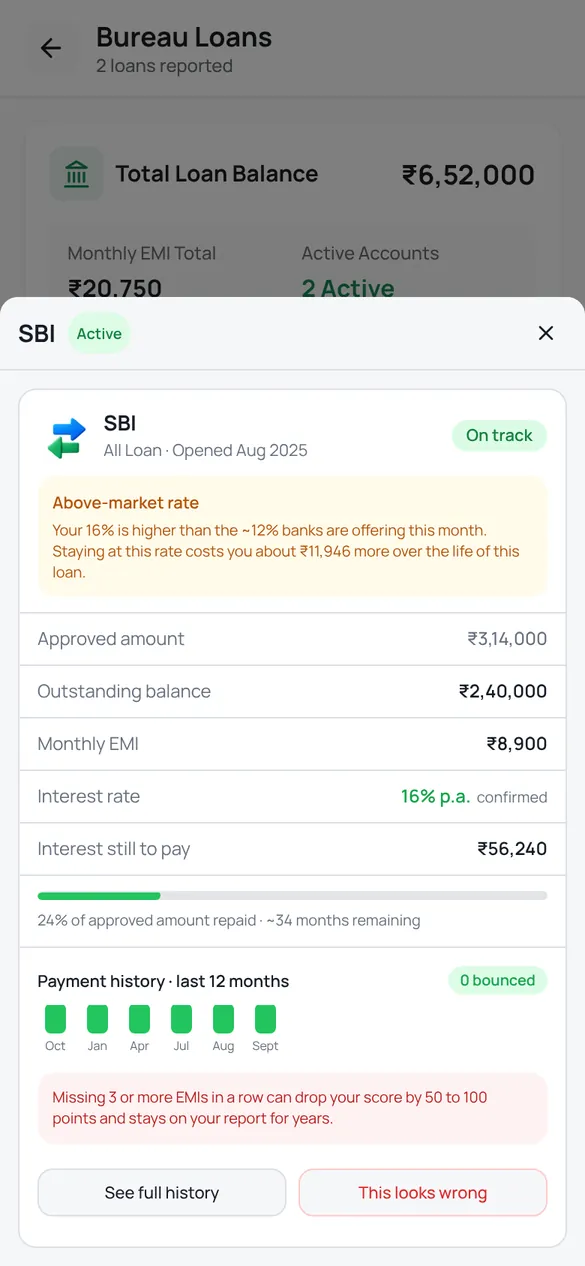
    Loan detail sheet flagging an above-market interest rate with the extra cost, outstanding balance and payment history

    3.Loans priced above the market

    A loan flagged when its rate is above what banks offer today.

    App screens with sample data for a sample user, not a real customer's account.

    Common questions

    What is the best expense tracker app in India?

    On the checks this page uses, Unyfy ranks first of 13: it tracks spending automatically from bank and card alerts, predicts the month on Pro so there is no budget to set, and offers nine features none of the other 12 apps' own pages offer, including card match, missed rewards, a savings-interest check and a loan overpay check. Fold and INDmoney follow for free bank-linked tracking, and FinArt for the widest pure tracking set. We make this page, so every claim about the other apps comes from their own listings, dated.

    Do I need to set a budget in an expense tracker?

    Not with every app. FinArt, Axio, Money Manager and Monefy are built around budgets you set by category. Unyfy works the other way: there is no budget to set, because on Pro its AI predicts next month's spends from your own transactions, starting with every EMI, SIP, rent payment, bill, subscription and automated transfer already committed, and shows what is paid and what is left. A budget suits you if you want to cap a category by choice; a prediction suits you if you want to know what the month holds without setting limits.

    Which expense tracker app works without a bank login?

    Several. Unyfy and FinArt read the transaction alerts your bank sends by SMS or email and never ask for your bank login. Fold, INDmoney and Jupiter use the RBI's Account Aggregator framework, which shares bank data with your consent and no password. Money Manager and Monefy need nothing because you type entries. Wallet's and Goodbudget's bank sync does ask for bank login details, and lists no Indian banks. Be wary of any tracker that asks for your UPI PIN.

    Is there a free automatic expense tracker in India?

    Yes. Unyfy's automatic tracking and diagnosis are free, with an optional Pro plan at ₹99 a month. Fold and INDmoney track free through the Account Aggregator bank link, and Axio's tracker is free on Android. FinArt offers a five-day free trial and then charges. Free apps earn somewhere: ours through Pro, commissions on loans and cards and a voucher margin; Fold through Plus and ads; INDmoney, Jupiter, CRED, Axio and Moneyview through the products they sell.

    Which expense tracker works on iPhone in India?

    iPhones do not let apps read SMS, so iPhone trackers work from email, a bank link, notifications or manual entry. Fold, INDmoney, Jupiter, CRED, FinArt, Money Manager, Monefy, Wallet and Goodbudget list iPhone apps; FinArt's iPhone listing makes automated tracking a paid feature. Unyfy works on an iPhone through its web app at app.unyfy.co.in, which reads bank email alerts and statements.

    Can an expense tracker track cash spending?

    Only if you enter it. No app sees cash automatically, because cash sends no alert. FinArt, Axio, Fold, Money Manager, Monefy, Wallet and Goodbudget let you add cash by hand, so a household that spends a lot in cash should use one of them, alone or alongside an automatic tracker.

    How do free expense tracker apps make money?

    Through one of four routes: ads (Money Manager's free version, Fold's free plan), a paid upgrade or subscription (Monefy, FinArt, Fold Plus, Wallet, Goodbudget), or selling financial products such as loans, cards, deposits and trading (INDmoney, Jupiter, CRED, Axio, Moneyview, ET Money). Unyfy combines a Pro plan with commissions on loans and cards and a margin on vouchers; its diagnosis stays free whether or not you take anything.

    The label expense tracker covers apps built for different jobs. Manual ledgers are precise and private but cost time and miss the payments nobody types. SMS and email trackers remove the typing and catch UPI. Bank-linked apps use the Account Aggregator framework. Lending- and investing-first apps attach a tracker to the products they sell. Unyfy ranks first here because it does the tracking automatically, predicts the month so there is no budget to set, and then turns the same data into checks on your card, your loans, your savings and your brand spending. Whatever you choose, read every free app's business model, and check any claim here against the app's own listing, which is where this page got it.

    Our Partners

    Banks and NBFCs we compare

    Unyfy compares offers from these lenders and earns a commission if you take one. The comparison is shown first, and it can tell you not to switch.

    HDFC Bank logo
    ICICI Bank logo
    Axis Bank
    State Bank of India logo
    IDFC First Bank logo
    Kotak Mahindra logo
    IndusInd Bank logo
    Yes Bank logo
    Bajaj Finserv logo
    Tata Capital logo